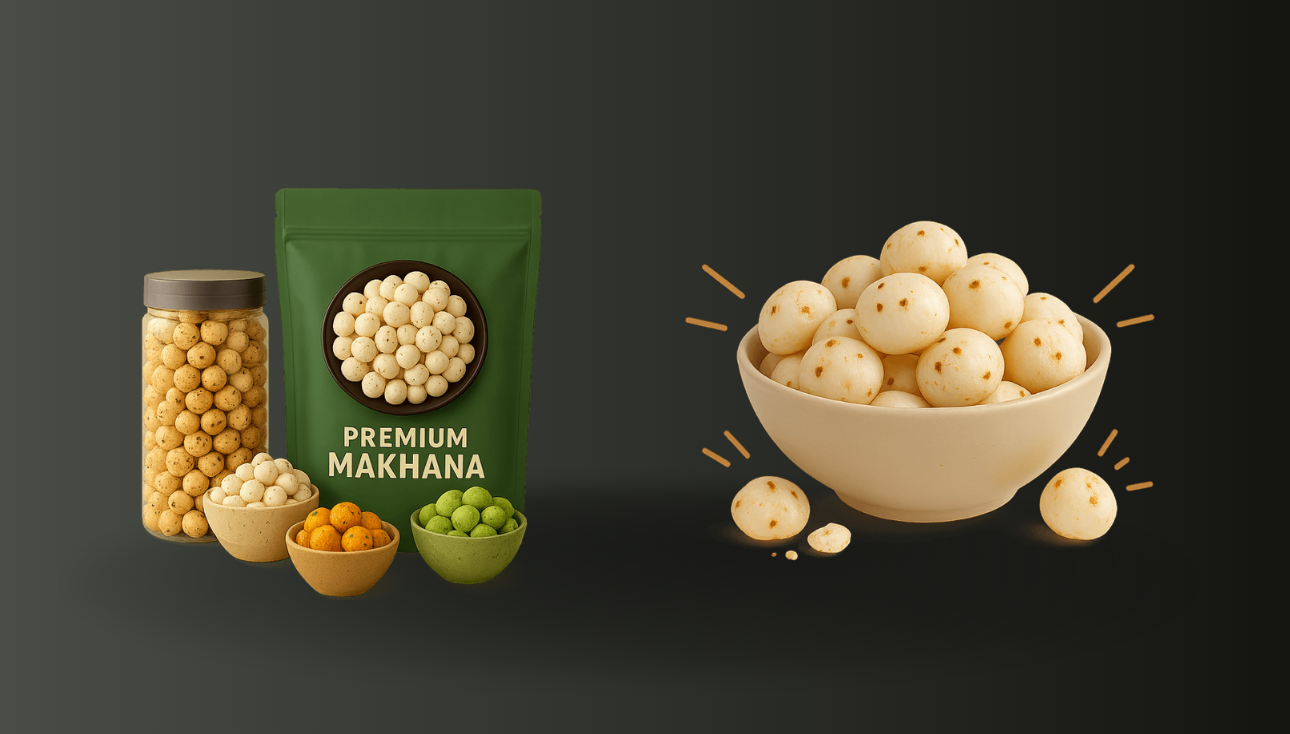
The Golden Harvest: A Complete Guide to Makhana from Farm to Global Export
Makhana, often called Fox Nuts or Lotus Seeds, has evolved from a
traditional Indian fasting food to a global superfood. It is mainly cultivated in the
wetlands of Bihar, India, which produces more than 90% of the world’s makhana.
The journey of makhana from ponds to international markets involves a fascinating
and labor-intensive process.
Part 1: Why Makhana? The Superfood Benefits
Before exploring the production process, it is important to understand why makhana
has become popular worldwide as a healthy snack.
- Nutrient Dense: High in plant-based protein and fiber while being low in calories and saturated fats.
- Heart Healthy: Rich in magnesium and potassium which help regulate blood pressure.
- Diabetic Friendly: Low Glycemic Index helps prevent sudden spikes in blood sugar levels.
- Anti-Aging Properties: Contains antioxidants like kaempferol that reduce inflammation.
- Gluten-Free & Vegan: A natural snack suitable for people with dietary restrictions.
Part 2: From Pond to Port — The Step-by-Step Journey
Phase 1: Cultivation & Harvesting (January – August)
The cultivation of makhana begins in stagnant ponds and lowland water bodies.
- Sowing: Seeds are sown in January and large leaves cover the water by April.
- Fruiting: Purple flowers bloom and fruits develop underwater.
- Harvesting: In August, fruits burst and seeds sink to the pond floor.
Harvesters dive into the mud to collect seeds using bamboo baskets known as Gaja.
Phase 2: Post-Harvest Processing (September – November)
During this phase, the raw black seeds are transformed into the familiar white puffed makhana.
- Cleaning & Sun Drying: Seeds are washed to remove mud and dried in sunlight.
- Grading: Seeds are sorted into different sizes for uniform heating.
- Pre-Heating & Tempering: Seeds are heated in iron pans and rested for 24–48 hours.
- The Big Pop: Seeds are roasted at very high temperatures (250°C–300°C)
and struck with a wooden mallet to produce the white puff known as Lawa.
Phase 3: Export Preparation
To meet international food standards, makhana undergoes additional finishing processes.
- Polishing: Removes remaining shell pieces and improves appearance.
- Flavoring: Some products are roasted with seasonings like peri-peri,
Himalayan salt, or cheese.
- Vacuum Packaging: Export-quality makhana is packed in nitrogen-flushed
airtight pouches to maintain freshness and extend shelf life.
Global Market & Packaging Standards
- Top Export Markets: USA, Canada, UAE, Australia
- Grading: Premium (18mm+), Standard (16–18mm)
- Packaging: Nitrogen-filled airtight pouches for longer shelf life